
Reviewed · AUSTIN SIGHTSEEING & DRIVING TOURS
Double Decker Austin Single Loop Sightseeing Tour
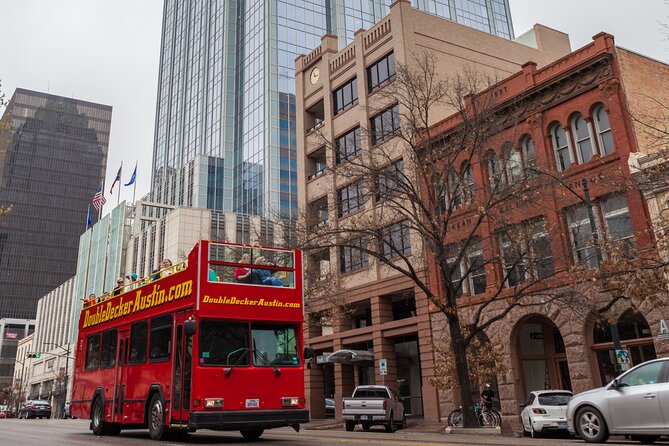
Downtown Austin looks good from two levels. This loop tour saves you from Googling bus routes and puts you on a two-deck bus with live guide commentary as you pass major downtown icons like the Texas State Capitol and the Driskill Hotel.
I especially like the choice between open-air top seating and a climate-controlled lower deck, depending on how warm (or windy) you feel.
I also love how the route helps you get your bearings quickly. In about 75–90 minutes, you get a guided pass through places you’ll want to visit later, including 6th Street, South Congress, UT-area landmarks, and the Congress Avenue bat zone.
One possible drawback: it’s a single loop with limited time at each stop. That means you’ll mostly see a lot from the road, and the focus stays on the big downtown highlights rather than every neighborhood detail.
In This Review
- Key things to know before you ride
- Why This Double-Decker Austin Loop Feels Like a Smart First-Day Plan
- Where You Board: Austin Visitor Center and the Two-Deck Setup
- Live Commentary on a Loop: What the Guides Add (and What to Keep in Mind)
- Historic 6th Street Entertainment District and the Convention Center Area
- Central Fire Station No. 1 and the Austin Fire Museum: A Standout Story Stop
- The Hannig Home and William Sydney Porter: Smaller Details, Big Context
- Driskill Hotel to Texas Capitol: From Old Glamour to Government Power
- Texas Governor’s Mansion and the LBJ Library Stop: Two Layers of Leadership
- UT Austin Highlights: Darrell K Royal Stadium and the 307-Foot Tower
- Bullock, Blanton, and the Ransom Center: Culture Stops Without Needing a Full Day
- Congress Avenue Bridge Bats and South Congress: Austin’s Most Photo-Literate Stretch
- Long Center and the Final Return to 5th Street
- Price, Timing, and Who This Tour Suits Best
- Should You Book This Double Decker Austin Single Loop Sightseeing Tour?
- FAQ
- How long does the Double Decker Austin Single Loop Sightseeing Tour take?
- Where does the tour start?
- Is the tour in English?
- Do I choose where I sit on the bus?
- What big sights does the route focus on?
- Is the ticket a mobile ticket?
- Is free cancellation available?
- Does the tour require good weather?
Key things to know before you ride
- Two-deck comfort: pick the breeze of the open top or the steadier temps downstairs.
- Live guided loop: commentary keeps you oriented as you roll past the major sights.
- Photo-friendly angles: the upper deck is built for skyline and landmark snapshots.
- A big hit of downtown in under 90 minutes: good for a first-day plan.
- Some stops are more about look-and-learn than long stays: manage expectations if you want lots of time walking.
- Weather matters: the tour is designed for good conditions, especially for top-deck viewing.
The whole of Austin in one loop




Why This Double-Decker Austin Loop Feels Like a Smart First-Day Plan

Austin is spread out in a way that can trick you. You can easily spend your first afternoon walking in circles, then realize you never made it to the real anchors: the Capitol area, UT landmarks, and the South Congress zone.
This tour is built to solve that problem. You’re paying $36.81 per person for a guided loop that compresses a lot of key landmarks into one flowing circuit, with live commentary along the way. The value isn’t just convenience. It’s the way the guide helps you connect the dots—so later, when you’re walking on your own, you’ll know what you’re looking at and why it matters.
I’d treat it like your orientation circuit. If you’ve got only a short visit—or if you want a break from walking—this loop gives you a map made of real streets, not just pins on your phone.
Where You Board: Austin Visitor Center and the Two-Deck Setup
You start near the Austin Visitor Center area at 103 E 5th St, in the downtown zone around Red River Street (between 4th and 5th). The tour ends back at the same meeting point, which is handy because you’re not left hunting for your next ride.
Inside the double-decker, you can choose how you want the experience to feel:
- The open-air top deck is great for views and photos.
- The lower deck is climate-controlled, which matters if it’s hot, windy, or you’re trying to avoid that constant temperature swing.
One practical note: Austin has trees and overhead branches, and you may have to duck a few times while you ride up top. That’s not a dealbreaker, but it’s annoying if you come expecting a totally hands-free view.
Live Commentary on a Loop: What the Guides Add (and What to Keep in Mind)

The tour runs with live guide narration, and you’ll hear stories as the bus moves past each stop. That narration is the difference between sightseeing as scenery and sightseeing as context.
In the feedback you’ll find a clear pattern: the guides who get high marks tend to be energetic and entertaining, with a good sense of humor and lots of local detail. Names that have come up in past experiences include Jason, Will, Lawrence, Brian, and Madi. You can’t choose who you get, but it tells you something important: the company’s best tours often hinge on the personality of the guide.
Now for the balanced part. Like any guided bus tour, you’ll want to take it as a fast overview, not a classroom lecture. A couple of experiences also point to occasional trivia hiccups and different comfort levels with humor. If you care deeply about one specific historical detail, it’s smart to verify later with your own reading after the tour.
Historic 6th Street Entertainment District and the Convention Center Area
Your route starts by moving through the Historic 6th Street Entertainment District. Even if you’re not planning to party, this strip is a great orientation anchor. You’ll understand how downtown energy clusters, where the foot traffic feels thick, and why people connect Austin to nightlife as much as live music.
Next you pass by the Austin Convention Center area. This part is useful because it shows the bigger downtown layout—how entertainment, events, and major civic spaces sit side by side.
What to expect here: more “pass-by and identify” than “walk around and explore.” If you want to go deeper into 6th Street later, this is a good place to decide what kind of Austin you’re in the mood for.

Central Fire Station No. 1 and the Austin Fire Museum: A Standout Story Stop
One of the more interesting segments on the loop is the stop connected to Central Fire Station No. 1 and the Austin Fire Museum. You’ll see uniforms, photographs, and memorabilia spanning the 19th to 21st centuries.
Why this works on a bus tour: it breaks up the usual Capitol-and-hotels pattern. You’re getting a slice of Austin’s daily-life history—how the city responded to emergencies and how that shaped local identity.
The trade-off is time. A museum stop on a loop tour is typically short. You may not get the long, slow reading you’d do on a full museum day. Still, it’s a memorable change of pace and a good reminder that Austin history is also about public services and community response.
The Hannig Home and William Sydney Porter: Smaller Details, Big Context
You’ll also stop at the 1869 home of Joseph and Susanna Dickinson Hannig, a house saved and deeded to the City in 2003. The story linked to this spot ties directly into Texas independence: Susanna Dickinson survived the Battle of the Alamo and carried news of its fall, which later connects to the Battle of San Jacinto and the defeat of Santa Anna.
Right after that, the tour includes William Sydney Porter (you’ll hear about his life in Austin, with time to look inside). This is one of the tour’s best “human scale” moments. Instead of just pointing at buildings, you’re hearing how specific people shaped Austin’s story.
This is where I’d suggest you stay mentally ready to listen. These are the kinds of stops where the guide’s voice really matters. If you tune out for even a few minutes, you’ll miss the through-line that makes the stop feel meaningful.
Driskill Hotel to Texas Capitol: From Old Glamour to Government Power
Next up, you pass the Driskill Hotel, a Romanesque-style building completed in 1886 and the oldest operating hotel in Austin. It’s closely tied to Col. Jesse Driskill and his idea of building the finest hotel south of St. Louis.
From there, the bus heads toward the Texas Capitol, which is recognized as one of the nation’s most distinguished state capitols and has major historic designations. Even if you’ve seen it in photos, riding past it helps you understand how it anchors downtown politics and civic life.
A helpful expectation-setting note: some experiences mention the bus may not slow down as much as you’d like near the Capitol area. So if you want a specific angle for a close-up shot, plan on grabbing photos when you can and not assuming you’ll get a long viewing window.
Still, overall, this segment is one of the strongest parts of the loop. It’s the classic Austin “big landmark” moment—just compressed.
Texas Governor’s Mansion and the LBJ Library Stop: Two Layers of Leadership

You’ll then head toward the Texas Governor’s Mansion, the official residence of Texas governors since 1856. The tour also covers the fact that it was severely damaged by arson in 2008 and has since been restored and is occupied again.
After that, the route includes time at a stop with exhibits, tours, a gift shop, and a travel center—and the itinerary specifically calls out the Lyndon Baines Johnson Library and Museum as part of the experience. This is where you connect Austin’s downtown landmarks to national leadership, not just state-level identity.
If you enjoy political history or want a sense of how Texas leadership is interpreted for visitors, this is a high-value pairing. If you’re less interested, think of it as context. Even a quick pass helps you understand why certain sites are treated as major pilgrimage points.
UT Austin Highlights: Darrell K Royal Stadium and the 307-Foot Tower
The loop continues into the UT Austin campus area with stops tied to:
- Darrell K Royal–Texas Memorial Stadium, home to the Longhorns since 1924
- The UT Austin Tower, a 307-foot landmark completed in 1937
This section is great even if you’re not a sports person. Stadiums and university towers act like visual signposts. They tell you where the city’s student life and tradition live, and they give you a different Austin texture than the Capitol zone.
In practical terms, it’s also a reminder that Austin isn’t only government and music. It’s academia, too, and UT shapes the city’s day-to-day rhythm.
Bullock, Blanton, and the Ransom Center: Culture Stops Without Needing a Full Day
The tour includes several culture-focused landmarks that feel almost too ambitious for a loop:
- Bullock Texas State History Museum (opened in 2001 as the official history museum of the State of Texas)
- Blanton Museum of Art, with a large collection that includes works spanning ancient Greek pottery through abstract expressionism
- The Ransom Center, described as a humanities research center with collections tied to literature and the creative process
If you love art and writing, you’ll appreciate that the tour doesn’t treat culture as optional. It gives you a chance to see these institutions in the middle of everything else.
The drawback to expect: time may be limited. A bus route means you’re usually scanning, listening, and choosing what you want to return to later. I’d walk away using this part to build a short list, then plan an art museum or literary stop on a separate outing.
Congress Avenue Bridge Bats and South Congress: Austin’s Most Photo-Literate Stretch
If there’s one “wait for it” moment on this tour, it’s the stop connected to the Congress Avenue Bridge bat colony. The data says you can see 750,000 to 1.5 million bats fly out near dusk, with best viewing dates from April to October.
This is one of those experiences where your timing matters. If you’re doing the tour outside the recommended season or earlier in the day, you might not get peak bat activity. Still, the stop is useful because it shows why this place is a defining Austin landmark.
Then you roll into South Congress (SoCo), known for its shops, eateries, galleries, and music venues. This is the stretch that helps you understand why people come back to Austin even after they’ve seen the headline attractions.
The vibe shift from government landmarks to everyday street life is one of the tour’s best benefits. It gives you a more complete mental picture of what Austin feels like across the day.
Long Center and the Final Return to 5th Street
Near the end, the route includes The Long Center, tied to performances, music, movies, festivals, and community events. It’s less about a single building you can obsess over and more about the idea that Austin’s culture is publicly shared and program-driven.
Then the tour returns to the Austin Visitor Center area, which is a smart place to end. You can recharge, grab a coffee, and use the visitor-focused area to plan your next moves.
Price, Timing, and Who This Tour Suits Best
At $36.81 per person, you’re not buying a full-day tour of just one neighborhood. You’re buying a guided orientation loop that covers a lot of ground in about 75–90 minutes. That cost makes sense when:
- You’re short on time and want to prioritize major landmarks
- You want a first-day plan that reduces guesswork
- You’d rather sit and listen than walk for hours in hot weather
The tour is set up for small groups, with a maximum of 35 travelers, which helps keep it from feeling like a mass cattle system.
I’d pick this tour if you’re traveling as a couple, solo, or with family and you want a guided overview without committing to a long multi-stop museum day. Most travelers can participate, and service animals are allowed. It’s also near public transportation, which helps if you don’t plan to drive.
One booking tip, based on the tour’s seasonal reality: it’s described as requiring good weather. If Austin’s doing its unpredictable thing, check your day. If you’re top-deck sensitive to wind or sun, the lower deck is your friend.
Should You Book This Double Decker Austin Single Loop Sightseeing Tour?
Book it if you want an efficient Austin highlights circuit with live commentary, flexible seating, and a route that hits the Capitol area, UT landmarks, South Congress, and the bat zone.
Skip it (or at least adjust expectations) if you’re looking for long walks, deep neighborhood exploration, or a slow, museum-style pace at every stop. This is a loop tour. You’ll learn a lot, but you’ll also move on quickly.
If you’re doing Austin for the first time, this is one of the easiest ways to set your bearings for the rest of your trip.
FAQ
How long does the Double Decker Austin Single Loop Sightseeing Tour take?
It runs about 1 hour 15 minutes to 1 hour 30 minutes.
Where does the tour start?
You meet at the Austin Visitor Center area at 103 E 5th St, Austin, TX 78701.
Is the tour in English?
Yes, the tour is offered in English.
Do I choose where I sit on the bus?
Yes. You can sit on the open-air top deck or the climate-controlled lower deck.
What big sights does the route focus on?
You’ll pass major downtown landmarks including 6th Street, the Driskill Hotel, the Texas State Capitol, and the Texas Governor’s Mansion, plus other UT and South Congress area stops.
Is the ticket a mobile ticket?
Yes, it’s listed as using a mobile ticket.
Is free cancellation available?
Free cancellation is available up to 24 hours in advance for a full refund.
Does the tour require good weather?
Yes. The experience requires good weather, and if it’s canceled for poor weather, you’ll be offered a different date or a full refund.
More Tour Reviews in Austin
- Best of Austin Small-Group Driving Tour with Local Guide
★ 5.0 · 2,275 reviews - Austin Biker Gang E-Bike Tour
★ 5.0 · 1,399 reviews - Austin Food Tour with Local Flavors, Tacos & 6 Food Tastings
★ 5.0 · 987 reviews - From Austin: Hill Country BBQ & Wine Shuttle
★ 5.0 · 954 reviews - Austin and Hill Country Sightseeing Tour
★ 4.5 · 928 reviews
Austin End to End
- Best of Austin Small-Group Driving Tour with Local Guide
★ 5.0 · 2,275 reviews - Austin and Hill Country Sightseeing Tour
★ 4.5 · 928 reviews - Austin and Hill Country Panoramic Sightseeing Tour
★ 5.0 · 310 reviews - Austin: Best of Austin Driving Tour with Local Guide
★ 4.9 · 248 reviews - Austin Sightseeing and Capitol Segway Tour
★ 5.0 · 246 reviews
Hot Off the Grill: New Austin Reviews
- Austin’s Treasures Private tour: A Heroic Downtown Discovery Walk★ 5.0 · 3 reviews
- Private Clear Kayak Tour on Lady Bird Lake in Austin, Texas★ 5.0 · 3 reviews
- Lake Austin Boat Cruise 1.5 Hour Scenic Tour BYOB Per Person★ 4.5 · 3 reviews
- Africa Hologram Adventure at Zoocade★ 3.5 · 3 reviews
- Go Tubing in Austin’s Downtown Spring River★ 5.0 · 3 reviews
Austin Sightseeing & Driving Tours, compared.
 ★ 5.0Best of Austin Small-Group Driving Tour with Local GuideFrom $492,275 reviews
 ★ 4.5Austin and Hill Country Sightseeing TourFrom $33928 reviews
 ★ 5.0Austin and Hill Country Panoramic Sightseeing TourFrom $73310 reviews
 ★ 4.9Best of Austin Driving Tour with Local GuideFrom $49248 reviews
 ★ 5.0Austin Sightseeing and Capitol Segway TourFrom $37246 reviews
 ★ 4.0Austin Premium Driving Tour with Sunset Boat CruiseFrom $94174 reviews
 ★ 4.5Austin Famous Ghost and Bat Segway TourFrom $69151 reviews
 ★ 4.8Electric Bike City Sightseeing TourFrom $69141 reviews
Browse the lists this tour appears in